


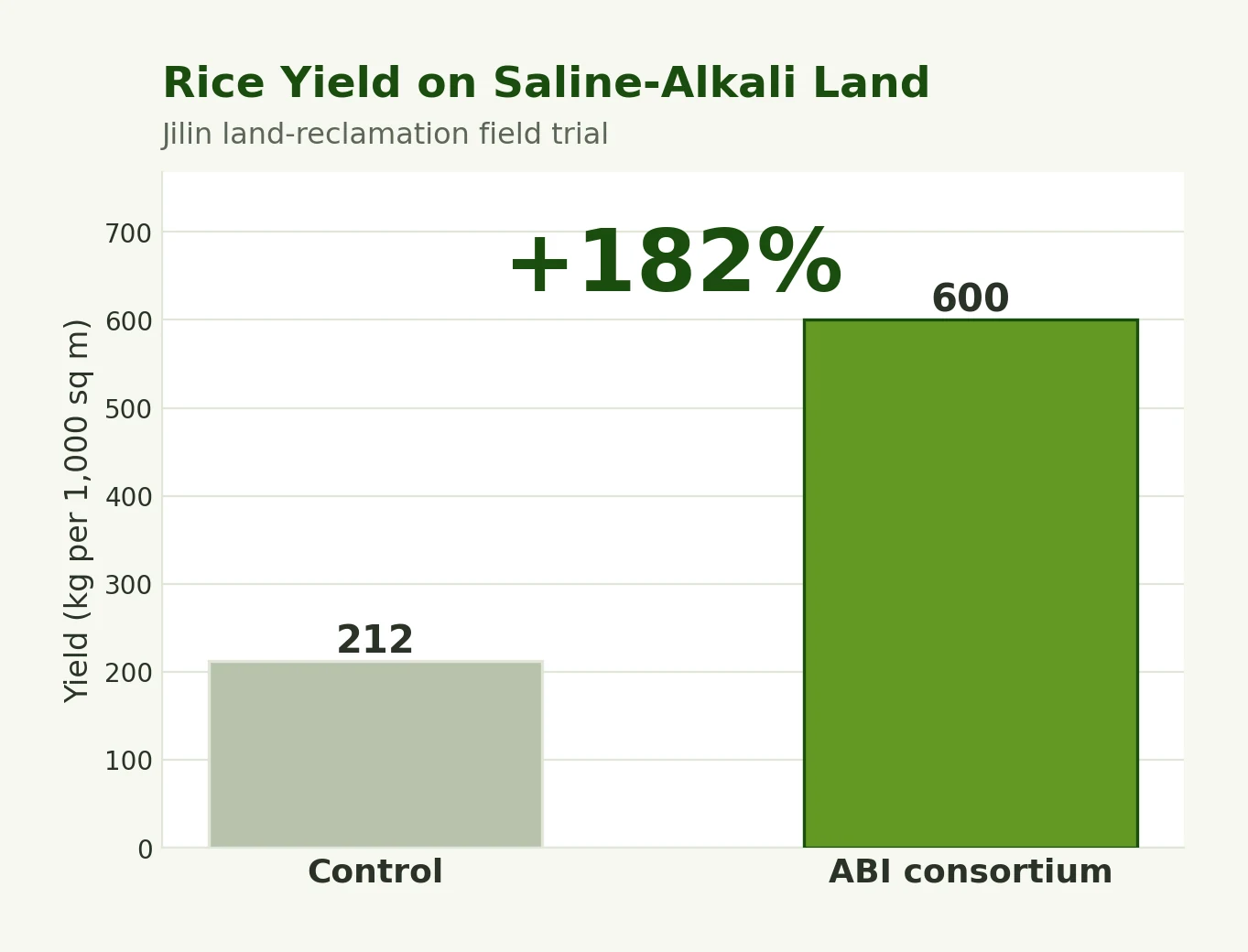
+182% rice yield on saline-alkali soil, nearly 3x the control
Request a QuoteA rice grower in Jilin Province, northeastern China was producing under severe saline-alkali conditions, with soil pH of 9 to 10 and salinity of 0.5 to 0.6%. In this region seedling emergence commonly falls below 50%, and long reliance on NPK fertilizers with limited rotation has degraded soil biology and yields. The trial evaluated whether an ABI microbial consortium of beneficial bacteria and fungi could improve rice performance under these conditions. Trial fields covered 3,500 m2, transplanted in June 2015 and harvested in October 2015. Both control and treated fields were pretreated with EM bacteria to begin pH and salinity neutralization, isolating the ABI consortium as the differentiating input. It was applied at a rate equivalent to 14.4 g per 1,000 m2 of the standard 50 billion CFU/g formulation, mixed into the soil at transplanting. No base fertilizer or pesticides were used, and a single mid-cycle NPK application was made.
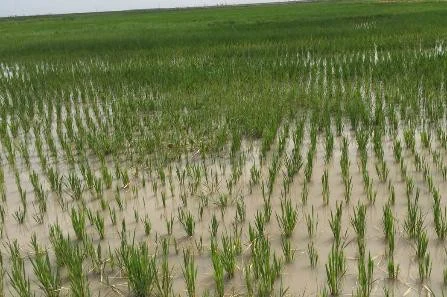
The adjacent control field yielded 212.5 kg per 1,000 m2, typical for rice on saline-alkali land in this region. High pH, elevated salinity, and depleted soil biology suppress seedling establishment and harvest, and the grower deliberately selected the plots with the highest salinity in the area to stress-test the product. These baseline yields make standard production economics difficult and often push fields out of viable cultivation.
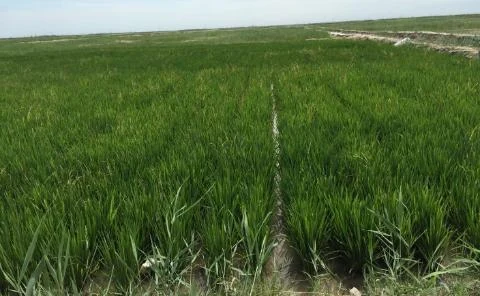
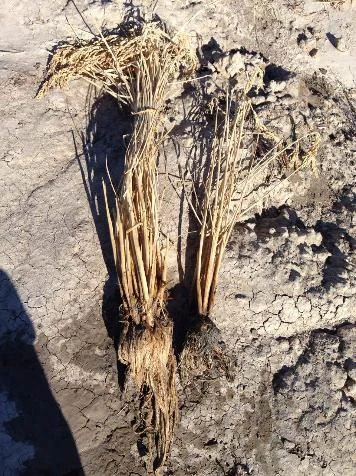
The treated field yielded 600 kg per 1,000 m2, a 182.35% increase and nearly triple the control. Because both fields received the same EM pretreatment and the same mid-cycle NPK, the difference reflects the added impact of the ABI consortium as the only differentiating input. One month after transplanting, treated plants showed thick, healthy green growth absent from the adjacent control, and at harvest root observations showed longer, more robust root systems. On high-pH, salt-affected land where conventional inputs alone had failed, the consortium restored competitive yields.
Built from beneficial bacteria and fungi that ABI manufactures in its own U.S. fermentation facility, including multiple Bacillus and Trichoderma species alongside Brevibacillus, Aspergillus, and Penicillium, each DNA-verified for identity and purity. Explore our strains.
Tell us your crop, region, and volume. We reply with pricing and documentation, factory-direct.
Request a Quote© 2026 Applied Biotech Industries | All Rights Reserved.

