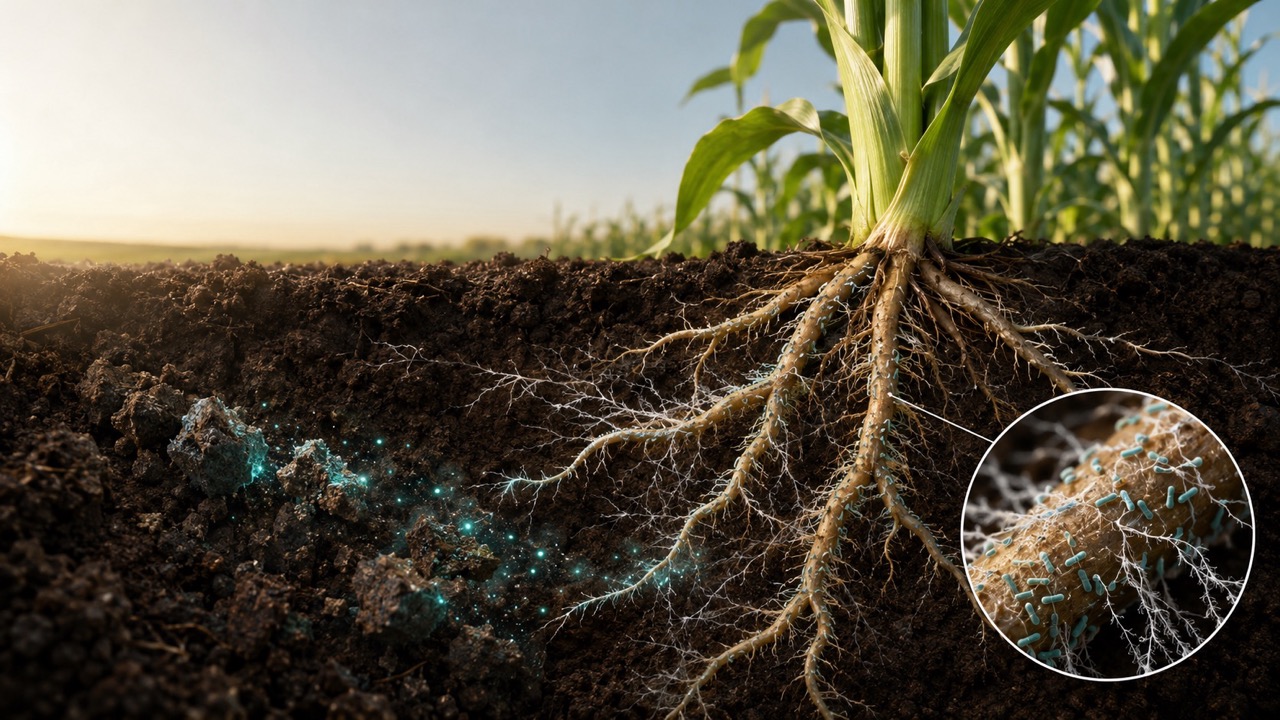
Phosphate-solubilizing bacteria and fungi are microbes that convert insoluble, soil-bound phosphorus into plant-available phosphate. They work mainly by secreting organic acids that free phosphate from calcium, iron, and aluminum complexes, and phosphatase enzymes that release phosphorus from organic matter. Common commercial strains include Bacillus megaterium, Bacillus amyloliquefaciens, Penicillium bilaiae, and Aspergillus niger. Used alongside conventional fertilizer, they improve phosphorus use efficiency, because an estimated 70 to 90 percent of applied phosphate is otherwise fixed in soil and never reaches the crop.
Phosphorus is one of the three macronutrients every crop needs in quantity, and it is also the one growers waste most. In many soils, most of the phosphate applied as conventional fertilizer never reaches the plant. It reacts with calcium, iron, and aluminum in the soil within days or weeks, forming insoluble compounds that roots cannot absorb. The phosphorus is still in the field, but it is locked away in a chemical vault.
Phosphate-solubilizing bacteria and fungi are the microbes that open that vault. Through organic acid secretion and phosphatase enzyme activity, these beneficial soil microbes convert bound, plant-unavailable phosphorus into soluble phosphate that crops can take up. They are among the most thoroughly studied microbial inoculants in agriculture, and they sit at the center of phosphorus use efficiency, a topic that matters more every year as fertilizer prices climb and supply tightens.
This guide explains what phosphate-solubilizing bacteria and fungi are, the mechanisms they use, which commercial strains deliver the function, how they fit into a conventional NPK program, and how to choose a phosphate-solubilizing inoculant. It is written for growers, agronomists, distributors, and formulators evaluating biofertilizers and custom microbial blends. ABI manufactures single-strain phosphate-solubilizing inoculants and custom blends at our Wisconsin facility. Each strain below links to its product page, and each major topic connects to a deeper resource in the ABI microbe library.
Field-tested benefits. In documented ABI commercial trials and grower case studies, results have included a 36 percent tomato yield increase with a $9,600 per acre gross profit gain in a Georgia field trial, a 31 percent potato yield increase over an untreated control, and 100 percent transplant survival in green peppers treated with a multi-strain inoculant compared to 70.8 percent in the control. Some ABI customers have additionally reported reducing applied phosphate and nitrogen fertilizer while maintaining or improving yield. These examples are not guarantees of performance. Microbial inoculant results depend on crop, soil chemistry, fertility program, climate, application timing, and overall management. Detailed case study summaries are available on request through ABI's contact form.
Key takeaways
- Phosphate-solubilizing bacteria and fungi convert insoluble, soil-bound phosphorus into plant-available phosphate.
- The core mechanisms are organic acid secretion, phosphatase enzyme activity, siderophore production, and mycorrhizal phosphorus foraging.
- Leading commercial strains include Bacillus megaterium, Penicillium bilaiae, Bacillus amyloliquefaciens, Aspergillus niger, Pseudomonas fluorescens, and endo mycorrhizae.
- They work best as an efficiency layer alongside an NPK fertility program, not a replacement for fertilizer.
- ABI manufactures single-strain and custom phosphate-solubilizing inoculants in Wisconsin for bulk, wholesale, OEM, and private-label buyers.
Table of contents
- Why phosphorus becomes unavailable in soil
- How phosphate-solubilizing bacteria and fungi work
- Commercial phosphate-solubilizing strains
- Integrating phosphate-solubilizing inoculants with NPK programs
- Application methods for phosphate-solubilizing inoculants
- Field results from ABI microbial programs
- Regulatory and label framing
- How to choose a phosphate-solubilizing inoculant
- Limitations and realistic expectations
- FAQ
1. Why phosphorus becomes unavailable in soil
Phosphorus drives root development, energy transfer, flowering, and grain or fruit fill. A phosphorus-deficient crop is stunted, late, and low-yielding, and the deficiency is often invisible until harvest comes in light. Yet phosphorus is uniquely difficult to manage, because it does not behave like nitrogen in the soil.
When phosphate fertilizer is applied, only a small fraction is taken up by the crop in the season it is applied. Estimates from soil science place the share of applied phosphate that is fixed into plant-unavailable forms at roughly 70 to 90 percent, depending on soil pH, mineralogy, and organic matter [1][5]. In acidic soils, phosphate binds with iron and aluminum. In calcareous and alkaline soils, it binds with calcium. Either way, the result is the same: phosphate moves out of the soil solution and into insoluble complexes within days to weeks, where it accumulates as a large but stranded reserve.
This is why many fields carry years of accumulated phosphorus in soil tests yet still respond to fresh phosphate applications. The total phosphorus is high, but the available phosphorus, the portion dissolved in the soil solution where roots can reach it, stays low. The agronomic problem is not a shortage of phosphorus in the ground. It is a shortage of phosphorus the plant can actually use.
Phosphate-solubilizing bacteria and fungi attack exactly this problem. Rather than adding more phosphate to a system that will fix most of it, these microbes mobilize the phosphorus that is already present, improving phosphorus use efficiency from both fresh fertilizer and the legacy reserve. In a period of high input costs and tightening phosphate rock supply, that shift from adding phosphorus to unlocking phosphorus is the central case for microbial phosphorus management.
2. How phosphate-solubilizing bacteria and fungi work
Phosphate-solubilizing microbes mobilize phosphorus through three complementary biochemical mechanisms. Most commercial strains deliver more than one. Understanding the mechanisms is the foundation of choosing the right strain for a soil and a cropping system.
Quick reference: phosphate mechanisms by strain family
MechanismWhat it doesStrain familiesExample ABI strainsOrganic acid secretionChelates Ca, Fe, Al bound to phosphate, releasing soluble phosphateBacillus, Penicillium, Aspergillus, PseudomonasB. megaterium, P. bilaiae, A. nigerPhosphatase enzyme activityHydrolyzes organic phosphorus from residue and soil organic matterBacillus, Penicillium, AspergillusB. amyloliquefaciens, P. bilaiaeSiderophore productionMobilizes iron, complementing phosphate uptake in calcareous soilsPseudomonas, BacillusPseudomonas fluorescensRelated mineral solubilizationReleases potassium and silicon via the same organic-acid pathwayBacillusB. mucilaginosusMycorrhizal phosphorus foragingExtends root reach via hyphae to acquire and transport immobile phosphateArbuscular mycorrhizal fungi (AMF)Endo mycorrhizae
2.1 Organic acid secretion
The primary mechanism of phosphate solubilization is the secretion of low-molecular-weight organic acids. Phosphate-solubilizing bacteria and fungi metabolize carbon sources in the rhizosphere and release acids such as gluconic, citric, oxalic, and 2-ketogluconic acid into the surrounding soil [2][3]. These acids do two things at once. They lower the local pH, and, more importantly, their carboxyl and hydroxyl groups chelate the calcium, iron, and aluminum cations that hold phosphate in insoluble complexes. As the cations are sequestered, the phosphate is freed into the soil solution as plant-available orthophosphate.
Gluconic acid is the most commonly reported agent of inorganic phosphate solubilization, produced by many Bacillus and Pseudomonas strains [2]. Fungal solubilizers such as Penicillium bilaiae and Aspergillus niger are prolific organic acid producers, particularly of citric and oxalic acid, which makes filamentous fungi especially effective at dissolving calcium-bound phosphate in alkaline soils [4].
2.2 Phosphatase enzymes
Not all soil phosphorus is mineral-bound. A large fraction, often 30 to 65 percent of total soil phosphorus, is held in organic forms: phytate, nucleic acids, phospholipids, and microbial residues. This organic phosphorus is unavailable to plants until it is mineralized. Phosphate-solubilizing microbes produce phosphatase enzymes, both acid and alkaline phosphatases, that hydrolyze these organic compounds and release inorganic phosphate [1][5]. Phytase, a specialized phosphatase, frees phosphorus from phytate, the dominant organic phosphorus pool in many soils.
This enzymatic route is the second pillar of microbial phosphorus mobilization, and it is why phosphate-solubilizing inoculants are valuable in high organic matter and residue-rich systems, where a meaningful share of the phosphorus reserve is organic rather than mineral.
2.3 Siderophore production and micronutrient support
Many phosphate-active bacteria also secrete siderophores, iron-chelating compounds that scavenge Fe(III) from soil minerals and deliver it to the rhizosphere. Pseudomonas fluorescens is a well-characterized siderophore producer. Siderophore activity matters for phosphorus management in a specific way: in high-pH, calcareous soils where phosphate is calcium-bound, iron availability is often low as well, and the same conditions that strand phosphorus also strand iron. Strains that combine organic acid and siderophore activity therefore support nutrient uptake on two fronts at once.
The same organic-acid chemistry that releases phosphate also acts on other mineral-bound nutrients. Bacillus mucilaginosus is best known as a potassium and silicon solubilizer, releasing K and Si from feldspar, mica, and illite through organic acid secretion, and it contributes phosphorus solubilization through the same pathway. For a dedicated treatment of potassium solubilization, see ABI's guide to potassium-solubilizing bacteria.
3. Commercial phosphate-solubilizing strains
The phosphate-solubilizing function is delivered commercially by a defined set of bacterial and fungal strains. Each has a distinct profile of mechanisms, soil fit, and complementary benefits.
Best phosphate-solubilizing microbes by use case
Buyer needRecommended strainsWhyGeneral phosphorus solubilizationB. megaterium, Penicillium bilaiaeReference bacterial and fungal solubilizers for phosphate availabilityAlkaline or calcareous soilPenicillium bilaiae, Aspergillus niger, Pseudomonas fluorescensOrganic acids dissolve calcium-bound phosphate; siderophores add iron mobilizationRoot establishmentB. amyloliquefaciens, B. megateriumCombine phosphate mobilization with PGPR root stimulationPhosphorus-limited, low-input systemsEndo mycorrhizae, B. megateriumMycorrhizal foraging plus organic-acid solubilizationBroad mineral solubilization (P, K, Si)B. mucilaginosus, B. megateriumReleases phosphorus alongside potassium and siliconCompost and high-residue systemsAspergillus niger, Aspergillus oryzaeEnzymatic decomposition releases organic phosphorusCustom multi-function blendsCustom Blend BuilderCombine solubilization, foraging, and root support
Bacillus megaterium
Bacillus megaterium is the reference phosphate-solubilizing bacterium and one of the most widely studied plant growth-promoting rhizobacteria in agriculture. It solubilizes bound phosphate through organic acid secretion, improves nitrogen cycling and fertilizer efficiency, and produces phytohormones that stimulate root and shoot growth. ABI supplies it as a 100 billion CFU per gram dry powder, applied at 100 to 200 grams per acre through drip, drench, or fertigation. Its broad tolerance to salinity, drought, and heavy metals makes it a dependable choice across a wide range of soils, and it is the natural lead strain in any phosphate-focused program.
Bacillus amyloliquefaciens
Bacillus amyloliquefaciens is a high-potency PGPR that pairs nutrient solubilization with strong root stimulation. It produces phytohormones, soil-decomposing enzymes that support phosphatase-driven mineralization, and microbial metabolites that support rhizosphere balance. For growers who want phosphorus mobilization and vigorous early root establishment in a single strain, B. amyloliquefaciens is the combined phosphate-plus-PGPR option.
Penicillium bilaiae
Penicillium bilaiae is one of the best-known commercial phosphate-solubilizing fungi, used for decades to improve phosphorus availability. It secretes citric, oxalic, and gluconic acids that dissolve mineral and organic phosphorus, promotes root elongation and seedling vigor under phosphorus-limited conditions, and works synergistically with mycorrhizal fungi. ABI supplies it as a 10 billion CFU per gram powder applied at 400 to 1,200 grams per acre, split across two to three applications. Where a grower wants a fungal complement to bacterial solubilizers, P. bilaiae is the standard.
Endo mycorrhizae (arbuscular mycorrhizal fungi)
Endo mycorrhizae, the arbuscular mycorrhizal fungi (AMF) used in agriculture, form a symbiosis with crop roots and are among the most important mycorrhizal fungi for phosphorus nutrition. Rather than solubilizing phosphate chemically, they extend a network of fine extraradical hyphae far beyond the root's own depletion zone, reaching and transporting immobile phosphate back to the plant. Because phosphorus moves very little through soil, this expanded foraging reach is one of the most effective biological routes to improved phosphorus uptake, and the contribution of arbuscular mycorrhizal fungi to plant phosphorus is among the best-documented relationships in soil science [9]. Mycorrhizae work synergistically with the organic-acid solubilizers: the solubilizers free phosphate into the soil solution, and the mycorrhizal network delivers it to the root. For phosphorus-limited and low-input systems, mycorrhizal fungi are a foundational component of a microbial phosphorus program.
Aspergillus niger
Aspergillus niger is a powerful organic acid and enzyme producer that solubilizes phosphorus, potassium, and micronutrients while accelerating organic matter breakdown. In a phosphate program it functions as a complementary solubilizer, particularly valuable in compost-amended and high-residue systems where its decomposition activity also releases organic phosphorus. It is positioned as a supporting strain rather than the primary phosphate anchor, and it pairs naturally with Aspergillus oryzae where decomposition is a priority.
Pseudomonas fluorescens
Pseudomonas fluorescens contributes to phosphorus programs through phosphate mobilization, siderophore-driven iron uptake, and auxin production that drives root development. Its value in a phosphate context is the combination of phosphate and iron mobilization, which makes it a useful partner strain in calcareous, high-pH soils.
Bacillus mucilaginosus
Bacillus mucilaginosus is primarily a potassium and silicon solubilizer, but it uses the same organic-acid mechanism that drives phosphate solubilization and contributes to phosphorus release. It belongs in a phosphate discussion as the strain that extends mineral solubilization beyond phosphorus to potassium, making it a common component of broad nutrient-unlock blends.
Additional phosphate-solubilizing Bacillus strains
Beyond the reference strains above, several other Bacillus and related species are documented phosphate solubilizers that score highly for phosphorus solubilization in ABI's strain profiling. Bacillus subtilis, Bacillus licheniformis, Bacillus pumilus, Bacillus methylotrophicus, and Brevibacillus laterosporus all contribute phosphate solubilization through the same organic-acid and phosphatase pathways, typically alongside complementary plant growth-promoting activity. They are strong candidates for multi-strain phosphate blends where breadth of function matters as much as peak solubilization from any single strain.
For multi-strain programs that combine several of these functions, ABI builds custom microbial blends specified by target function, CFU concentration, and application method.
Not sure which strains to combine? ABI blends any of these phosphate solubilizers to spec. Build a custom blend or talk to our team.
4. Integrating phosphate-solubilizing inoculants with NPK programs
Phosphate-solubilizing inoculants are not a replacement for a fertility program. They are an efficiency layer on top of it. The most reliable way to think about them is as a tool to get more crop-available phosphorus out of every unit of applied or soil-resident phosphate, which in many systems allows a measured reduction in applied phosphate while holding yield.
Peer-reviewed research supports this efficiency framing. Inoculation with phosphate-solubilizing microorganisms has been associated in field and greenhouse studies with improved phosphorus uptake and, in many cases, the ability to maintain yield at reduced phosphate fertilizer rates [1][3][6]. The mechanism is straightforward: the microbes increase the share of the phosphorus pool that reaches the plant, so the same crop demand is met from a smaller external input.
Compatibility is the practical consideration. Phosphate-solubilizing strains are generally tolerant of standard nitrogen, phosphorus, and potassium fertilizers at normal application rates, and they are most effective when applied close to the root zone through drip, drench, or fertigation. They should not be tank-mixed with herbicides, and direct mixing with concentrated fungicides, bactericides, or strong oxidizers should be avoided. Because these are living inoculants, application timing matters: early root establishment and transplanting are the highest-value windows, with reapplication during active growth as the crop cycle and label direct.
It is worth being precise about category. ABI's phosphate-solubilizing products are biofertilizers and microbial inoculants. They improve nutrient availability and crop performance. They are not pesticides and are not registered as such, a distinction covered in Section 6.
5. Application methods for phosphate-solubilizing inoculants
How a phosphate-solubilizing inoculant is applied matters as much as which strain is chosen, because these are living products that perform best when delivered close to the active root zone. The table below summarizes the common application methods for phosphate-solubilizing bacteria and fungi.
Application methodBest fitNotesSoil drenchVegetables, transplants, nursery cropsPlaces microbes directly in the root zoneDrip irrigation and fertigationFertigated row and specialty cropsReliable root-zone delivery; flush lines after applicationIn-furrowRow crops and planting-time programsUseful for early root establishmentSeed treatmentSelected row crops and legumesRequires formulation and compatibility testingCompost or amendment blendingOrganic-matter-rich and regenerative systemsGood fit for fungi and enzyme-active strainsFoliarLimited fit for phosphate solubilizationRoot-zone application is generally preferred
Across all methods, avoid tank-mixing with herbicides and direct contact with concentrated fungicides, bactericides, or strong oxidizers, and apply during early root establishment or transplanting for the highest-value window.
6. Field results from ABI microbial programs
ABI maintains a library of documented commercial trials and grower case studies. The results below are reported as commercial-trial documentation, not as guarantees, and outcomes depend on crop, soil, fertility program, and management.
These are not phosphate-only trials. They are examples of ABI microbial inoculant programs that included nutrient-cycling, root-zone, and soil-health functions relevant to phosphorus efficiency and plant performance. They demonstrate program-level outcomes rather than the isolated effect of a single phosphate-solubilizing strain.
In a Georgia tomato field trial, a Sunrise multi-strain program produced a 36 percent increase in yield and gross profit, equal to roughly 800 more cartons per acre and a $9,600 per acre gross profit increase, against a product cost of $115 per acre. The grower also reported a marked improvement in vegetation, plant size, and root strength.
In a potato trial, the treated field yielded 31.43 percent more than the untreated control, lifting yield from 58,035 to 76,275 kilograms per hectare, with superior tuber uniformity.
In a green pepper trial using ABI's Multi-Tricho multi-strain inoculant, the treated group achieved 100 percent transplant survival, 24 of 24 plants, compared with 70.8 percent, 17 of 24, in the control, and the treated plants outgrew the control by an average of 35 centimeters. Trichoderma-based inoculants support phosphorus availability indirectly by accelerating organic matter breakdown and strengthening root-zone biology, which complements the direct solubilizers covered above.
These outcomes are consistent with the core premise of microbial phosphorus management: when more of the phosphorus already in the system reaches the plant, root systems establish faster and yield potential rises. Full case study summaries, including dosage, application method, and timeline, are available through the contact form.
7. Regulatory and label framing
ABI's phosphate-solubilizing strains are biofertilizers and microbial inoculants. They are sold to improve nutrient availability, phosphorus use efficiency, and crop performance. They are not registered with the US EPA as pesticides, and this guide makes no claim that they control, kill, suppress, or prevent any pest, weed, or disease.
This distinction is the dividing line in product regulation. A biofertilizer or biostimulant supports plant growth and nutrient uptake and is regulated as a soil amendment or biostimulant depending on jurisdiction. A biopesticide makes explicit pest, weed, or disease-control claims and requires formal pesticide registration. Where the scientific literature describes mechanisms such as organic acid secretion, phosphatase activity, or siderophore production, those are descriptions of how the microbes interact with nutrients in the soil, not product performance claims about pest or disease control.
For buyers operating in Latin America, microbial inoculants are registered through national agricultural authorities such as SENASICA in Mexico, SENASA in Peru and Argentina, ICA in Colombia, and SAG in Chile. Product registration as a fertilizer or biostimulant is a separate path from any pesticide registration, and the buyer or distributor takes that path according to their market.
8. How to choose a phosphate-solubilizing inoculant
Selecting a phosphate-solubilizing inoculant comes down to four questions.
First, what is the objective: phosphorus only, or phosphorus plus broader plant growth promotion? For pure phosphate mobilization, Bacillus megaterium and Penicillium bilaiae are the reference bacterial and fungal choices. For phosphorus combined with vigorous root establishment, Bacillus amyloliquefaciens delivers both.
Second, what is the soil? In high-pH, calcareous soils where iron is also limiting, a siderophore producer such as Pseudomonas fluorescens adds value alongside a primary solubilizer. In high-residue or compost-amended systems, the enzymatic and decomposition activity of Aspergillus niger helps release organic phosphorus.
Third, what is the application method and system? Drip, drench, and fertigation systems that place the inoculant near the root zone get the most from these strains. CFU concentration determines how many grams deliver the effective dose, and ABI supplies high-CFU powders with custom concentrations on request.
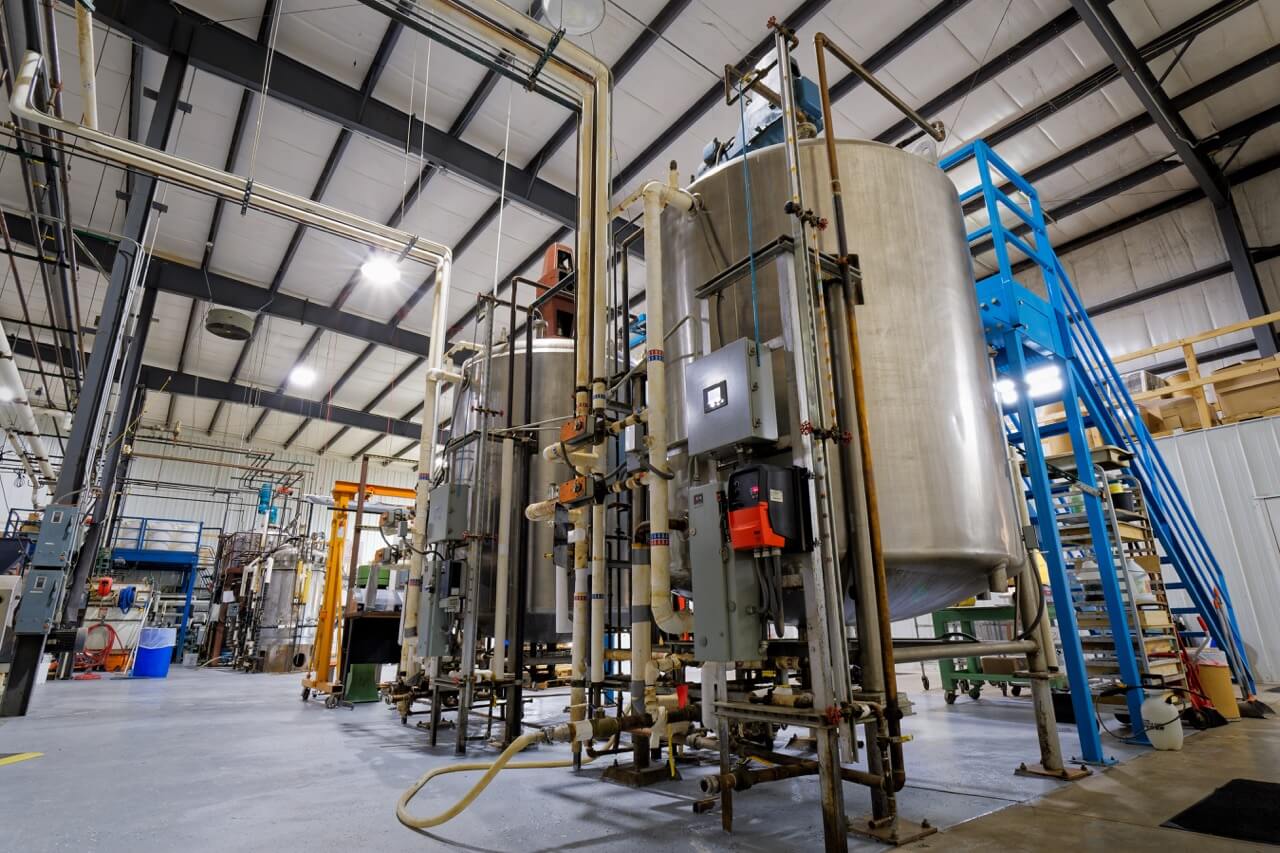
Fourth, who is the manufacturer? Strain identity, viability through storage, and formulation quality determine whether an inoculant performs in the field. ABI manufactures more than two dozen bacterial and fungal strains at our Wisconsin facility for bulk, wholesale, OEM, and private-label customers, and can develop a custom microbial blend matched to crop, soil, application method, CFU target, and packaging format.
ABI is a phosphate-solubilizing bacteria and fungi supplier as well as a formulator. We manufacture single-strain powders, multi-strain blends, and high-CFU microbial concentrates for agricultural input companies, distributors, and private-label brands, with bulk, wholesale, and OEM options built around crop, soil, application method, CFU target, and packaging. Learn more about custom agricultural microbial blends or spec one through the Custom Blend Builder.
Put the phosphorus you already have to work. Tell us your crop and system through the Custom Blend Builder or the contact page, and we will spec a phosphate program and quote.
9. Limitations and realistic expectations
Phosphate-solubilizing microbes are an efficiency tool, not a guarantee, and honest expectations make for better programs. A few practical limits apply.
Results depend on conditions. Soil pH, the form of phosphorus present, organic matter, moisture, and temperature all influence how much a strain delivers, and response varies by crop and system.
Living products need to stay alive. Viable CFU at the time of application is what matters, so storage, handling, and avoiding direct contact with concentrated salts, strong oxidizers, fungicides, bactericides, and herbicides all affect performance.
They complement fertility, they do not replace it. Severe phosphorus deficiency may still require phosphate inputs. The microbes improve the efficiency of what is applied and what is already resident in the soil.
Placement and guidance matter. Field response is strongest when the inoculant is delivered near the active root zone, and any decision to reduce applied phosphate should be grounded in soil tests and agronomic guidance.
References
FAQ
What are phosphate-solubilizing bacteria?
Phosphate-solubilizing bacteria are soil bacteria that convert insoluble, plant-unavailable phosphorus into soluble phosphate that crops can absorb. They work mainly by secreting organic acids that release phosphate bound to calcium, iron, and aluminum, and by producing phosphatase enzymes that free phosphorus from organic matter. Common commercial species include Bacillus megaterium and Bacillus amyloliquefaciens.
How do phosphate-solubilizing fungi differ from bacteria?
Phosphate-solubilizing fungi such as Penicillium bilaiae and Aspergillus niger are especially prolific producers of citric and oxalic acid, which makes them effective at dissolving calcium-bound phosphate in alkaline soils. Fungi also contribute strongly to organic matter decomposition, releasing organic phosphorus. Bacteria and fungi are complementary, and many programs use both.
Do phosphate-solubilizing microbes replace phosphate fertilizer?
No. They improve the efficiency with which applied and soil-resident phosphorus reaches the plant. Because an estimated 70 to 90 percent of applied phosphate is otherwise fixed into unavailable forms, improving that efficiency can allow a measured reduction in applied phosphate while maintaining yield, but the microbes are an efficiency layer on a fertility program, not a replacement for it.
Which phosphate-solubilizing strain is best for my crop?
Bacillus megaterium and Penicillium bilaiae are the reference bacterial and fungal solubilizers. Bacillus amyloliquefaciens adds strong root promotion. Pseudomonas fluorescens helps in high-pH soils where iron is also limiting. Aspergillus niger suits high-residue systems. The best choice depends on objective, soil, and application method, and ABI can build a custom blend.
How much yield improvement can I expect?
Results depend on crop, soil, fertility program, and management. Documented ABI commercial trials have reported a 36 percent tomato yield increase and a 31 percent potato yield increase against untreated controls. These are documented trial outcomes, not guarantees.
Are phosphate-solubilizing inoculants compatible with my fertilizer program?
Yes, in most systems. They tolerate standard nitrogen, phosphorus, and potassium fertilizers at normal rates and are most effective applied near the root zone through drip, drench, or fertigation. Avoid tank-mixing with herbicides and direct mixing with concentrated fungicides, bactericides, or strong oxidizers.
Do these products work in alkaline or calcareous soils?
Yes. Organic-acid-producing fungi such as Penicillium bilaiae and Aspergillus niger are well suited to dissolving calcium-bound phosphate in alkaline soils, and siderophore-producing strains such as Pseudomonas fluorescens add iron mobilization where high pH also limits iron.
What CFU concentration do ABI phosphate strains supply?
ABI supplies high-CFU powders, for example Bacillus megaterium at 100 billion CFU per gram and Penicillium bilaiae and Aspergillus niger at 10 billion CFU per gram, with custom concentrations available on request.
Are phosphate-solubilizing inoculants safe for organic production?
Many strains are compatible with organic and regenerative systems, but certifier approval varies by region. Always verify the specific product formulation against your certifier's input requirements before use.
Are these products regulated as pesticides?
No. ABI's phosphate-solubilizing products are biofertilizers and microbial inoculants, not pesticides, and are not registered with the US EPA as pesticides. They are sold to improve nutrient availability and crop performance.
Can I buy phosphate-solubilizing strains in bulk or for private label?
Yes. ABI manufactures single-strain phosphate-solubilizing inoculants and custom blends for bulk, wholesale, OEM, and private-label customers globally. Specifications and quotes are available through the contact page or the Custom Blend Builder.
How does phosphorus get fixed in the soil in the first place?
Applied phosphate reacts quickly with calcium in alkaline soils and with iron and aluminum in acidic soils, forming insoluble compounds that roots cannot absorb. The phosphorus remains in the field but moves out of the soil solution, which is why total soil phosphorus can be high while plant-available phosphorus stays low.
How do you apply phosphate-solubilizing bacteria?
They are applied near the root zone through soil drench, drip irrigation, fertigation, in-furrow application, seed treatment, or blending with compatible soil amendments. Root-zone placement during early root establishment or transplanting generally gives the best response, and the inoculant should not be tank-mixed with herbicides or concentrated chemical products.
Are phosphate-solubilizing bacteria used in biofertilizers?
Yes. Phosphate-solubilizing bacteria and fungi are core ingredients in biofertilizers, microbial inoculants, soil probiotics, and custom agricultural blends. ABI supplies them as single strains and custom multi-strain formulations for bulk, wholesale, OEM, and private-label buyers.
What is the best phosphate-solubilizing fungus?
Penicillium bilaiae is one of the best-known commercial phosphate-solubilizing fungi, valued for organic acid production and root-zone phosphorus release. Aspergillus niger is also widely used where organic acid and enzyme activity support nutrient solubilization and organic matter breakdown.
Put your soil's phosphorus to work
ABI manufactures phosphate-solubilizing bacteria and fungi and custom blends for bulk, wholesale, and private-label buyers. Tell us your crop and we will spec a phosphate program.