Get the free ABI crop trial results pack
12 documented field trials, with real yield, root, and quality gains by crop. Enter your email and it is yours.
Thanks. Here's your pack:
Download the pack (PDF)CFU stands for colony forming units, the standard measure of live, reproducing microorganisms in a product. One CFU is one viable cell or cluster of cells that grows into a countable colony on a lab plate, so CFU counts only what is alive. Microbial inoculants are specified in CFU per gram; agricultural products typically range from about 1 billion to 500 billion CFU per gram depending on species, and the delivered dose per acre is what matters.
Every microbial product sold in agriculture carries a number like "100 billion CFU per gram" on its label, and that number decides what the product is worth. CFU stands for colony forming units, the standard unit for counting live microorganisms. It is the difference between buying a bag of active biology and buying a bag of carrier powder with a nice label, which is why distributors, ag retailers, and growers who handle microbial inoculants need to know how the number is produced, what a realistic count looks like, and where label claims and delivered counts part ways.
This reference covers the definition, the lab method behind the number, realistic CFU ranges by organism type, and the questions that separate a verifiable count from a marketing figure. It is written for the people who buy, stock, and resell microbial inoculants, and it draws on the QC practices ABI runs on every batch at our Wisconsin facility.
Key takeaways
- CFU counts only living, reproducing microorganisms. Dead cells do not form colonies and do not count.
- One CFU is not always one cell. Clumps, chains, and spore clusters that grow into a single colony count once, which is one reason CFU and microscope cell counts differ.
- Realistic finished-product counts run from about 1 billion to 500 billion CFU per gram depending on the organism. Spore-forming Bacillus species sit at the top of that range; non-spore-formers run lower.
- Mycorrhizal products are the exception: AMF cannot be fermented and are measured in propagules per gram, not CFU.
- The number that matters is delivered CFU per acre: CFU per gram times grams applied, at the moment of application, not at the moment of manufacture, with every claim converted to the same unit of finished product first.
- Every ABI batch is PCR-verified for strain identity before release and ships with a Certificate of Analysis stating its CFU per gram.
Table of contents
- What does CFU mean?
- How CFU is measured and calculated
- What CFU counts are realistic?
- Label claims vs delivered counts
- How to compare products on CFU
- CFU in multi-strain blends
1. What does CFU mean?
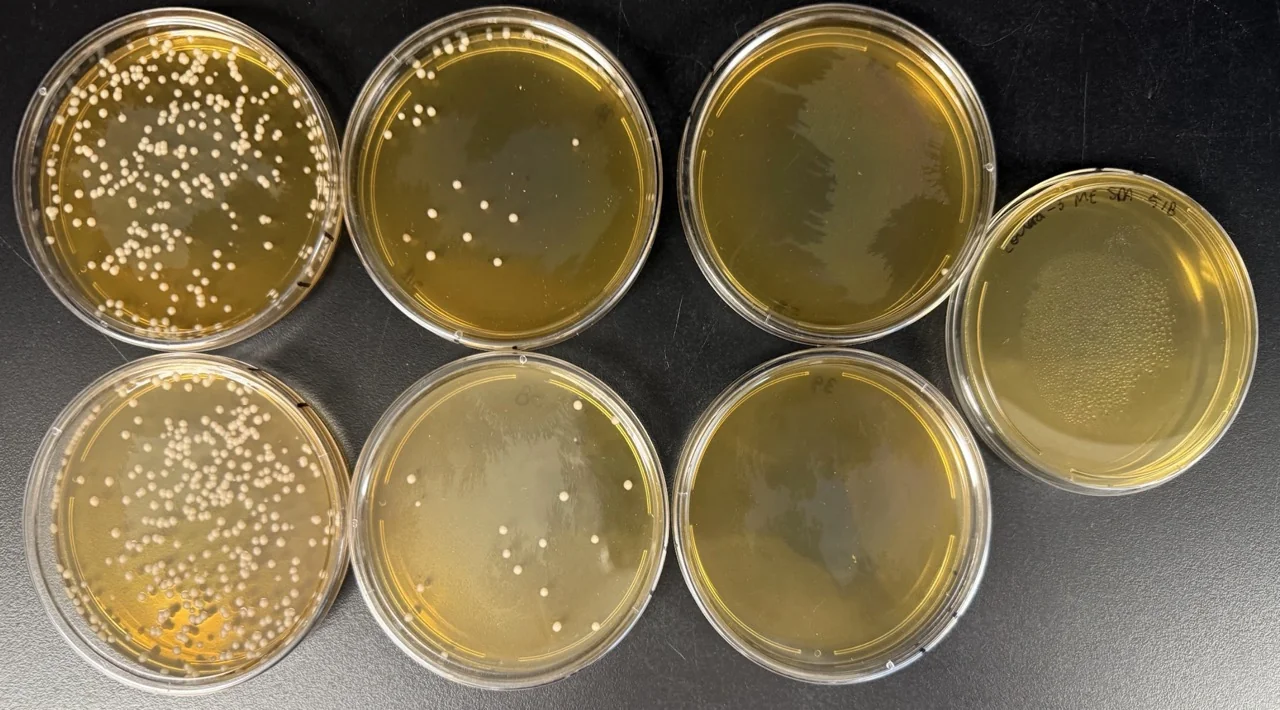
CFU stands for colony forming units. It is the standard unit microbiologists use to count microorganisms that are alive and able to reproduce. The method behind the name is simple: spread a diluted sample across a nutrient plate, incubate it, and every viable cell or viable cluster of cells grows into a visible colony. Count the colonies, correct for the dilution, and you have the CFU count of the original sample [1][2].
CFU counts only the living. A dead cell sits on the plate and does nothing. That makes CFU an honest measure for a product whose entire value is live biology, and it is why inoculant labels use CFU rather than total cell mass or protein content. A product can be full of microbial material and still count near zero if the organisms did not survive manufacturing or storage.
A colony forming unit is also not always a single cell. Bacteria that grow in chains or clumps, and spores that stick together, land on the plate as one unit and grow into one colony. The count is of units capable of founding a population, which is the agronomically relevant number, but it also means CFU always reads somewhat lower than a direct microscope count of the same sample [2]. Neither number is wrong. They measure different things, and CFU is the one that predicts what happens in your soil.
The same unit appears on probiotic supplements, yogurt labels, and water-quality reports, because it is the universal currency of viable microbiology. In agriculture it is specified as CFU per gram for powders and CFU per milliliter for liquids.
2. How CFU is measured and calculated
The standard method is serial dilution and plate counting, little changed in a century and still the reference method in regulatory manuals such as the FDA's Bacteriological Analytical Manual [1].
A concentrated product cannot be counted directly; a gram holding billions of organisms would bury a plate in overlapping colonies. So the lab dilutes the sample in repeated tenfold steps, plates a known volume from the dilutions, incubates, and picks the plates that land in a countable window, conventionally around 25 to 250 colonies per plate [1]. The calculation is then:
CFU per gram = (colonies counted x dilution factor) / volume plated
In practice it looks like this. The lab dilutes one gram of product a billionfold in steps, spreads a measured volume on a plate, and incubates it. Suppose 150 colonies grow. Each one traces back to a billion CFU in the original gram, so the batch tested at roughly 150 billion CFU per gram. The scaling is the whole trick: dilute until the colonies are countable, then multiply back up.
One reading note: labels and Certificates of Analysis often state these numbers in scientific notation. 1 x 10¹¹ CFU per gram is 100 billion; 5 x 10¹⁰ is 50 billion. Same number, written two ways.
Serial dilution counting carries known statistical error, roughly plus or minus 10 to 30 percent even in careful hands, which is why regulators and manufacturers count multiple plates and report averages [2]. It is also why a batch tested at 105 billion CFU per gram against a 100 billion spec is the same product, and why chasing two-digit precision in a CFU claim misreads how the measurement works.
For spore-forming organisms, labs often run the count after a heat-shock step that kills vegetative cells and leaves spores. The result is a spore count, the number most relevant to shelf life. ABI tests every production batch for CFU count and verifies strain identity by in-house PCR before release, and each batch ships with a Certificate of Analysis stating the verified CFU per gram.
3. What CFU counts are realistic?
CFU per gram in a finished product is set by the organism's biology, the fermentation, and the drying step, and the achievable ranges differ sharply by organism type. Numbers far outside these ranges deserve questions.
| Organism type | Typical finished-product range | Why |
|---|---|---|
| Spore-forming bacteria (Bacillus species) | 10 billion to 500 billion CFU/g | Spores survive drying and storage almost unharmed; highest counts in the industry |
| Non-spore-forming bacteria (Pseudomonas species) | 1 billion to 100 billion CFU/g | Vegetative cells lose viability in drying; careful formulation required |
| Fungi (Trichoderma, Penicillium, Beauveria) | 1 billion to 50 billion CFU/g | Counted from conidia (spores); hardy but bulkier than bacterial spores |
| Mycorrhizal fungi (AMF) | Not measured in CFU | Obligate symbionts grown on living roots; measured in propagules per gram, anywhere from tens to thousands depending on concentration |
Three practical readings of that table.
Spore-formers earn their dominance. Bacillus subtilis, Bacillus megaterium, and their relatives hold counts through drying, ocean freight, and a season in an unrefrigerated warehouse, which is why they anchor most commercial catalogs. ABI's single-strain powders run from about 10 billion to 500 billion CFU per gram depending on species and customer specification.
A lower count is not a defect when the biology explains it. Pseudomonas fluorescens forms no dormant spores, so Pseudomonas products across the industry typically top out below the highest Bacillus counts and need better storage. ABI's runs up to 100 billion CFU per gram, a strong figure for a non-spore-former, and judged per organism delivered to the root zone a Pseudomonas product can be excellent. Trichoderma harzianum and other fungi are counted from their conidia and land in between.
And mycorrhizae are a different unit altogether. AMF cannot be fermented, so endomycorrhizal products are grown on living host roots and measured in propagules per gram. Market products range from tens of propagules per gram in dilute granulars to the thousands in concentrated powders; ABI's Endo Mycorrhizae is specified at 6,000 per gram, and even the most concentrated products stay in the tens of thousands, never the billions. A mycorrhizal label bragging in billions is measuring something else. The guide to mycorrhizal fungi in agriculture covers how to read those labels.
4. Label claims vs delivered counts
The gap between the CFU on the label and the CFU in the bag at application time is the quality question in this industry. Independent surveys of commercial inoculants have repeatedly found products testing below their label claim or carrying contaminants, a problem documented across markets for years [3][4]. The causes are ordinary: counts stated at manufacture rather than at sale, storage decay along the distribution chain, formulations that were never stable, and in the worst cases numbers that were never measured at all.
Viable counts decline over time in every living product. The question is how fast. A spore-based powder stored cool and dry can hold spec for one to two years or more at room temperature, and refrigeration stretches that further, often to two or three years or more. A non-spore liquid stored in a hot warehouse can lose most of its count in months. This is why the meaningful version of a CFU claim is guaranteed through the stated shelf life, not measured once at the factory door.
Watch the unit under the number. Two label patterns deserve a second look. Some liquid products state an impressive CFU per milliliter, then disclose elsewhere that the active ingredient is 1 percent of the jug. If the count describes the concentrate rather than the finished product, the real number in the tank is a hundred times smaller: 8.3 billion CFU per milliliter of a 1 percent active fraction is about 83 million per milliliter of what you actually pour. Others state the count per pound instead of per gram. Six trillion CFU per pound sounds enormous and works out to about 13 billion per gram, an ordinary figure. Before comparing anything, convert every claim to CFU per gram or per milliliter of the finished product. A label that makes that conversion hard is telling you something too.
A buyer can cut through most of this with four questions:
- Is the CFU count stated per batch on a Certificate of Analysis, or only printed on the label?
- Is the count guaranteed at point of sale or through shelf life, or only at time of manufacture?
- What are the storage conditions and dating, and does the distribution chain actually meet them?
- Is strain identity verified per batch, so the count is of the organism on the label?
A manufacturer running real QC answers all four in writing without friction. ABI verifies strain identity by in-house PCR before release, states the verified CFU per gram on the CoA of every batch, retains batch records for traceability, and publishes storage conditions and shelf life on each product's technical sheet.
5. How to compare products on CFU
CFU per gram on its own does not rank products. What ranks them is what it costs to put an effective dose on an acre, and that takes three steps to compare.
First, compute the delivered dose. CFU per gram times grams applied per acre gives CFU per acre, and that is the number field research connects to results. A 100 billion CFU per gram product applied at 100 grams per acre delivers 10 trillion CFU per acre; a 10 billion product applied at 1,000 grams delivers the same dose in a heavier, bulkier form.
Second, compute cost per delivered dose. Divide the cost per acre by the CFU per acre and the premium product often turns out cheaper than the bargain bag, because concentration cuts freight, storage, and handling along with the price per unit of biology. For distributors, high-concentration powder is also the cheaper thing to ship and warehouse per unit of product sold.
Third, weigh the things CFU does not measure. The right species for the job matters more than any count, which is where the strain-by-function guides come in. Formulation stability decides whether the count survives to application. And verified identity decides whether the CFU are of the organism you think you are buying. A billion CFU of the right strain beats a trillion of the wrong one.
6. CFU in multi-strain blends
Blends add one more piece of label arithmetic. Every gram of a finished blend is shared among its components, so each strain's individual CFU is a fraction of the total, and adding more strains divides the gram further. A label that lists ten strains and one impressive total count is telling you very little about the dose of any single organism.
Ask for the per-strain guarantee instead of the total, and be suspicious of blends where a cheap-to-produce filler strain plausibly carries the headline number while the expensive functional strains ride along at trace levels. It is the bacterial version of the inflated-count pattern on mycorrhizal labels. Blend design is a real discipline of balancing strain count against delivered dose per strain, covered from the buyer's side in the custom microbial blend manufacturing guide, and it is why ABI specifies custom blends by target function and per-strain CFU through the custom blend builder rather than by headline totals.
For buyers: ABI manufactures single-strain inoculants and custom blends at verified CFU specifications in Wisconsin, each batch PCR-verified for strain identity and released with a Certificate of Analysis stating CFU per gram. Request specs and pricing or spec a blend.
References
FAQ
What does CFU stand for?
CFU stands for colony forming units. It is the standard measure of live, reproducing microorganisms in a sample: each viable cell or cluster of cells grows into one countable colony on a lab plate. Because dead cells form no colonies, CFU counts only the biology that can actually work in your soil.
Is 1 CFU the same as 1 bacterium?
Not exactly. Cells that grow in chains or clumps, and spores that stick together, land on the plate as one unit and count as one CFU. So CFU reads somewhat lower than a direct microscope cell count of the same sample. CFU is the number that matters agronomically, because it counts units capable of founding a living population.
How do you calculate CFU?
By serial dilution and plate counting. The sample is diluted in tenfold steps, a known volume is spread on nutrient plates, and after incubation the lab counts plates in the 25 to 250 colony range. CFU equals colonies counted times the dilution factor, divided by the volume plated, converted back to per-gram or per-milliliter of the original product.
What is a good CFU count for a microbial inoculant?
It depends on the organism. Spore-forming Bacillus products legitimately reach 10 to 500 billion CFU per gram. Non-spore-formers like Pseudomonas run lower by nature, and fungal products fall in between. What matters is the delivered dose: CFU per gram times the application rate, guaranteed at point of sale rather than at manufacture.
Why do mycorrhizal products not list CFU?
Arbuscular mycorrhizal fungi are obligate symbionts that can only be multiplied on living host roots, not fermented like bacteria. Their products are measured in propagules per gram, counting spores, colonized root fragments, and hyphal fragments. AMF specs run from tens of propagules per gram in dilute granular products to thousands in concentrated powders; billions is a unit for bacteria.
Do CFU counts drop during storage?
Yes, in every living product; the question is how fast. Spore-based powders stored cool and dry can hold their count for one to two years or more, and refrigerated storage can extend that to two or three years or more. Non-spore liquids in hot storage can lose most of their count in months. Buy on counts guaranteed at point of sale or through shelf life, and follow the technical sheet's storage conditions.
Is a higher CFU count always better?
No. The right species for the target function matters more than any count, and the meaningful comparison is cost per CFU delivered per acre, not CFU per gram in isolation. A lower-count product of the correct organism, applied at the right rate, outperforms a high-count product of the wrong one.
How can I verify a CFU claim?
Ask for the batch Certificate of Analysis stating CFU per gram, ask how strain identity is verified, confirm whether the count is guaranteed at sale or only at manufacture, and check that batch records are retained for traceability. Any independent microbiology lab can also run a plate count on a sample. A manufacturer running real QC provides all of this without friction.
What is the difference between CFU and AFU?
AFU stands for active fluorescent units, a count made by flow cytometry: cells are stained and counted with a laser, including viable cells that would not grow on a plate. AFU readings therefore run higher than CFU for the same sample, and the two are not interchangeable. AFU appears mostly on probiotic labels; agricultural inoculants are specified in CFU, so compare products within one unit.
Get batch-verified CFU counts
Every ABI batch is verified for strain identity and ships with a Certificate of Analysis stating CFU per gram. Ask us for specs and pricing.